The Out-of-Sight Economics of the Marching Arts

The $1.5 Million Lot (And Why We're Talking About Tax Returns)
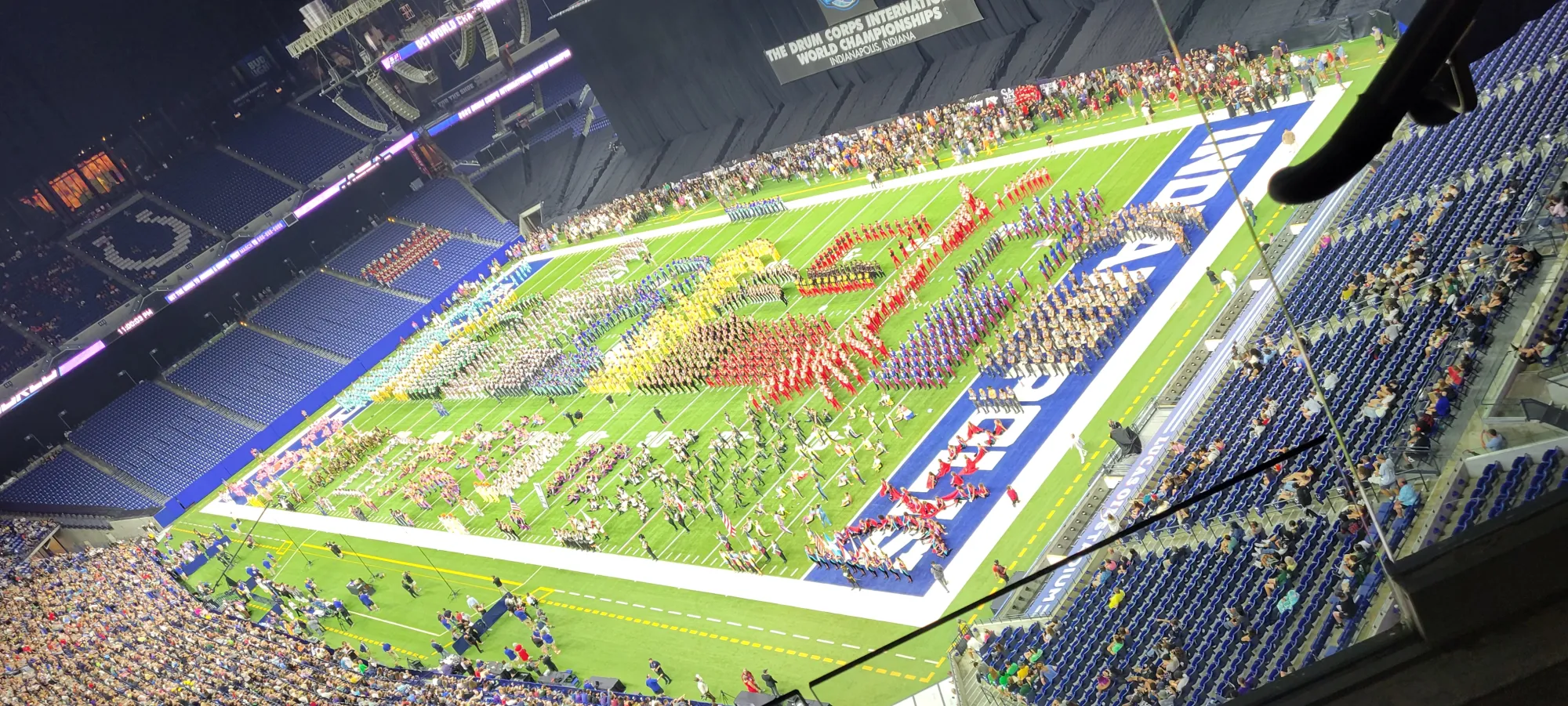
Walk through the warm-up lot outside Lucas Oil Stadium in Indianapolis on Finals night and you're looking at a million-dollar arms race. Every World Class corps rolls up with a fleet of charter buses, two custom-painted semi-trailers, a stadium-sized wireless audio rig, $40,000 worth of towering field props, a 50-person staff, and 165 performers wearing custom-printed costumes they will never wear again after tonight.
It looks like the richest youth activity on earth. Until you open the IRS tax returns and realize almost every single organization in that parking lot is one bad summer away from financial ruin.
Where is all that money coming from, and who is actually pocketing it?
Why Are We Talking About Tax Returns?
First, a quick introduction: I'm Jason. I marched in the Crossmen hornline from 1998 to 2001, volunteered during spring training in 2002, and I'm an old friend of dciscores.com co-creator Alan (who marched in the Troopers hornline right before my time). I am not a CPA, a Wall Street economist, or a DCI insider. I'm an IT guy, photographer, and a hornline vet who still loves this activity enough to wonder why a summer of drum corps now costs as much as a used Honda Civic.
This is the first in a series of articles I'm putting together for dciscores.com. In future pieces, I want to dig into the creative side of the activity: the pitfalls of "modern" show design, how WGI indoor trends and copyright lawyers reshaped the field, and what I believe the judging sheets are actually rewarding.
So why start a drum corps series with an article about economics? Because every time I tried to write down my thoughts about why modern shows look and sound the way they do, why durable uniforms vanished, or why historical corps are folding, the trail led me to money, and I kept thinking of a famous quote from Detective Lester Freamon in HBO's The Wire: "You follow drugs, you get drug addicts and drug dealers. But you start to follow the money, and you don't know where the f*** it's gonna take you."
I've been following Corps since I entered into the activity, and I've been scratching my head at some of the things happening in this activity. So if you're like me, and you want to understand some of the puzzling decisions of modern drum corps, you have to start following the money instead.
A Quick Note on How This Was Researched and Written: Because I'm an IT guy with a day job and not an investigative journalist with a staff of interns, I used an AI research assistant to help me dig through decades of public IRS Form 990 tax filings, federal fuel and inflation tables, and corporate buyout records, and to help organize and draft this piece.
To be clear: this wasn't a "hey ChatGPT, write me an article about drum corps" prompt. Every thesis, hornline memory, and opinion here is mine, shaped over dozens of back-and-forth revisions. In fact, I specifically instructed the AI to challenge my assumptions whenever the data disagreed with me (which is how I went in half-expecting to find fat-cat salaries at DCI headquarters, only for the tax returns to prove the exact opposite). More importantly, you don't have to trust me or an AI for a single number on this page: every claim in "The Receipts" sections below links directly to the raw IRS Form 990 filings and primary sources so you can check the math yourself.
Part 1: The $6,500 Summer (And Why "Gas Prices" Doesn't Cut It)
Back when Alan and I marched in the late nineties, a summer of drum corps wasn't cheap unless you marched with one of the few West Coast or Midwest corps whose local bingo halls practically printed money. For the rest of us, base tour fees were already sitting around $2,000 to $3,000, before winter camp fees, plane tickets (for some), show shoes, rehearsal gloves, the bottle of green Gold Bond, the extra large DCT balm, and a three-gallon jug of sunscreen. It hurt, sure. But if you worked a part-time job during the school year or hustled sponsorships, a normal working-class kid could still afford to march.
Today, base World Class tuition runs $5,400 to $6,300+ (for example, Carolina Crown charged $5,750 for 2025 and Santa Clara Vanguard charged $5,450). Throw in $200 just to show up at an audition camp, winter weekend fees, and flights, and a single summer routinely hits $7,500 to $9,000 out of pocket, and that's before the 2AM truck stop buy stops!
Bring that up online and someone will immediately respond with a variation of: "Have you seen the price of diesel, or how expensive food costs are now?"
Fair enough. Let's give that argument its full credit first, because touring a drum corps in the 2020s really is a financial nightmare compared to 1999 (which wasn't a picnic to begin with!):
- Diesel hits everything twice. You aren't just fueling four buses and two equipment semis at $4.58 to $5.35 a gallon on the 2026 summer tour (and diesel kept climbing after the tour, setting an all-time record of $6.53 a gallon about six weeks after 2026 Finals, a ticking time bomb waiting for next year's tour budgets). You're also paying diesel freight surcharges on every Sysco and Gordon Food Service truck delivering enough calories to keep 165 kids and 50 staff members from passing out in Texas in July.
- The old volunteer bus fleet is dead. In the nineties, corps bought beat-up MCI buses, had volunteer mechanics keep them running with duct tape and prayers, and put staff members behind the wheel. Federal DOT Electronic Logging Device (ELD) rules, CDL driver shortages, and commercial insurance killed that off. Now you pay commercial charter rates or you don't leave the lot.
- High schools stopped giving away free gym floors. Twenty-five years ago, housing was a handshake deal with a local band director who was a drum corps nut. Today, school district lawyers and post-COVID policies mean corps get billed $1,000 to $3,000 a night for facility rentals, AC, and mandatory school security overtime.
- Kids aren't sleeping on bus floors anymore. After 2018, the activity finally started taking member safety seriously. That means paying for certified athletic trainers, medical staff, background checks, and proper meals instead of Mystery Meat and PB&J.
- Local bingo died in most states. State lotteries, casinos, and phone-app sports betting wiped out the local charity bingo games that used to subsidize corps in the eighties and nineties.
So no, tour fees were never going to stay at $2,000.
Even after you give corps directors a pass for every single one of those costs, their excuse falls apart the second you look at what they chose to spend money on next.
When a normal business or nonprofit watches its basic survival costs (fuel, food, rent, insurance) go through the roof, it cuts luxury spending. Drum corps did the exact opposite. Right as keeping buses on the road became unaffordable, the activity threw itself into the most expensive on-field arms race in its history: throwaway single-season costumes, $40,000 rolling jungle gyms that require a second semi-truck (and more diesel) just to haul, stadium-sized wireless audio rigs, and 50-person instructional staffs.
📊 The Receipts (For the Math Nerds)
- The Inflation & Fuel Check: According to the Bureau of Labor Statistics (CPI Inflation Calculator) and the U.S. Energy Information Administration (Gasoline and Diesel Fuel Update):
- U.S. General Inflation (2000 → 2025): Up about 87% (~1.87x, using CPI-U annual averages of 172.2 in 2000 and 321.9 in 2025). A $2,000 tour fee in 2000 adjusted for standard inflation is about $3,740 today. Even a $2,500 fee is about $4,670, which is still roughly $700 to $1,600+ below current base tuition before a single camp fee.
- U.S. Retail Diesel (1998–2001 → 2025–2026): Annual averages rose from $1.04–$1.49/gal in the late nineties to $3.66–$3.76/gal in 2024–2025. During the 2026 summer tour (late June through the Aug. 8 Finals), weekly prices ran $4.58–$5.35/gal, then hit an all-time record of $6.53/gal the week of September 21, 2026 (EIA weekly series, 2026). The previous record was $5.81 in June 2022.
- The 2014–2016 Diesel Crash Test: Between 2014 and 2016, U.S. retail diesel prices dropped by 40% (annual average of $3.82/gal down to $2.30/gal; EIA annual averages). I couldn't find a single World Class corps that lowered its tuition when fuel prices cratered. Tuition kept climbing right through the dip because the extra cash was immediately eaten by props, electronics, and design budgets.
Part 2: The Hostage Situation (Opening the IRS Tax Returns)
When a parent writes a $6,500 check so their kid can spend 80 hours a week rehearsing on blisteringly hot parking lots, line fields, and load semi-trucks for free, it's natural to assume somebody at the corps is getting rich.
Except we don't have to guess. Because every World Class corps and its parent organization, Drum Corps International, are registered 501(c)(3) charities, their IRS Form 990 tax returns are public record. Anyone can pull them up on ProPublica's Nonprofit Explorer.
When you read the tax returns, you realize the corps aren't the villains pocketing the cash. The corps and the marching members are locked in the trunk together.
Take a mid-tier corps's total annual spending and divide it by a 150-to-165-member roster, and the actual cost to put one World Class member on tour for a summer works out to roughly $10,000 to $12,000. That means when a kid pays $6,000 in dues, the corps is still $4,000 or more in the hole on that kid's spot before the buses even pull out of spring training.
The corps take 100% of the public anger over sky-high tuition, carry 100% of the legal and financial risk, and live one blown bus engine or bad fundraising year away from folding. Santa Clara Vanguard had to sit out the 2023 season entirely after their finances cratered. The Cadets suspended operations after the 2023 season and folded for good in April 2024 (F GH). Even championship-caliber corps like Carolina Crown (2013 World Champion, 2026 bronze medalist) finished Fiscal Year 2024 with a net margin of -$4,082 on a $3.6 million budget.
A Tale of Two Corps: Crossmen vs. Troopers
Look at my old corps (The Crossmen) and Alan's old corps (The Troopers). When we marched in the late nineties, Crossmen was a perennial Top-10 powerhouse (finishing 6th to 10th from 1997 to 2001) out of Pennsylvania and Delaware, while the Troopers were struggling down in 19th to 25th place out of Casper, Wyoming.
Since then, our two corps traded places. The Troopers have been back in Finals every August since 2022 throwing down huge theatrical productions, while the Crossmen have been fighting for their lives in the 14th to 17th place trenches (15th at the 2026 Semifinals).
Did folks in San Antonio just forget how to teach brass and drill? Or does Texas lack marching music talent? Heck no! So let's look at their tax returns and financial disclosures and see what we can infer.
Both corps spend roughly the same amount to put a show on the field today (about $1.64M to $1.83M a year). The difference is how they are allowed to pay for it:
- The Wyoming Fundraising & Gaming Engine: Up in Casper, the Troopers don't have to bleed their marching members dry because local fundraising and donors cover the bills. In the early 2010s, Wyoming charitable gaming netted the Troopers $430,000 a year (on nearly $3M in gross play). Even as net bingo margins tightened in recent years, the Troopers built a massive Wyoming donor and fundraising machine that pulls in $730,000 to $890,000+ a year in grants and contributions alongside $320,000 a year from fundraising events. Backed by a $1.4 million net-asset cushion, the Troopers only rely on member tuition and program revenue for 29% of their budget.
- The Texas Squeeze: Meanwhile, Crossmen never had a solo bingo engine on the East Coast, and moving to Texas in fall 2006 didn't give them one either. As Crossmen's board explained in its November 22, 2023 financial update to alumni, Texas charitable bingo revenue is capped around $100,000 a year, with about $80,000 as a realistic long-term goal (and their newly launched Texas bingo was only yielding a $15,000 run rate). Worse, Crossmen's donor base was raising 6 to 9 times less than peer corps.
- Selling the Building Just to Make the Line: Without a multi-million-dollar donor base, roughly 60% to 70% of Crossmen's entire budget ($1.1M+ a year) comes from program revenue, most of it out of marching members' pockets. By the end of fiscal 2022, weighed down by pre-COVID operational debts and a $657,000 mortgage and notes balance, Crossmen's net assets actually went negative. After spending three years paying off operating debts left over from 2017–2019, Crossmen told alumni in November 2023 that it was selling assets, including its San Antonio headquarters building, and moving to a virtual office to fund its 50th-anniversary season in 2024. And as their board warned alumni at the time, those one-time asset sales would not be there in 2025. You can only sell your building once.
What About DCI Headquarters?
If the corps are broke, what about the league office in Indianapolis? Surely Drum Corps International is sitting on a mountain of cash from Lucas Oil Stadium ticket sales and streaming subscriptions?
Nope. Pull up DCI's tax returns and you'll find that Indy isn't some bloated pro-sports empire with a commissioner making Roger Goodell money. The whole operation is basically a glorified pass-through co-op.
Almost all of DCI's revenue comes from ticket sales and tour events. There are no seven-figure fat cats in the C-suite, and the twenty-something full-time office staffers in Indianapolis are making normal nonprofit wages while splitting the payroll budget with 160 seasonal summer event workers. Once DCI pays to keep the lights on at Lucas Oil Stadium, covers the regional domes, pays the judges, and runs the tour schedule, it ships the leftover cash right back out to the member corps. In a normal touring year, DCI's bottom-line profit margin is thinner than the bottoms of my Dinkles after finals.
📊 The Receipts (Strap in math nerds, normies can skip to the next section)
Pulled directly from IRS Form 990 filings (via ProPublica's Nonprofit Explorer) and official corps disclosures:
- Proof #1: Drum Corps International Inc. (EIN 36-2754480) Breaks Even (Almost) to the Penny:
- Where the money comes from: Roughly 89% to 95% of DCI's $10.7M–$13.7M annual revenue comes directly from event and ticket revenue (
Program Service Revenue). - A Lean Payroll (
~$1.8M–$2.2Mtotal): DCI reports 187 total W-2s (Form 990 Part I, Line 5), which covers ~20–25 full-time Indianapolis HQ staffers plus ~160 seasonal summer tour/event workers and interns. - C-Suite Pay (
Form 990 Part VII): Former CEO Dan Acheson topped out at $253,610 base (+$32,028 other compensation) before retiring in late 2023; successor Nate Boudreaux (Nov 2023–May 2026) made $208,222 in FY24; CFO (and 2026 Interim CEO) Jennifer Clevenger made $106,598 base (+$42,001 other compensation). (Former Blue Stars CEO Brad Furlano took over as DCI's CEO on September 1, 2026.) Subtracting the CEO and CFO leaves~$1.4Mfor the remaining ~20 full-time staffers and 160 seasonal workers. All Board of Directors members receive $0. - The ~0.3% Margin: Across six normal touring seasons (2015–2019 and 2023), DCI's net surplus or deficit never exceeded +$36,927 or -$37,048 (about one-third of one percent). FY2024 ran a small deficit of -1.57%:
- One honest caveat on reserves: DCI's net assets jumped from about $0.8M before COVID to $5.4M–$5.6M after the 2021 pandemic year, when it booked $6.46M in COVID relief grants and contributions. That's a post-pandemic rainy-day reserve, not an annual operating profit engine.
- Where the money comes from: Roughly 89% to 95% of DCI's $10.7M–$13.7M annual revenue comes directly from event and ticket revenue (
| DCI Fiscal Year | Total Revenue (totrevenue) |
Event / Ticket Revenue (totprgmrevnue) |
Corporate Sponsors / Grants (totcntrbgfts) |
Total Expenses (totfuncexpns) |
Net Margin (Rev minus Exp) | Margin % |
|---|---|---|---|---|---|---|
| FY2024 | $13,693,341 | $12,236,522 (89.4%) | $845,460 | $13,908,760 | -$215,419 | -1.57% |
| FY2023 | $13,271,365 | $12,424,888 (93.6%) | $676,223 | $13,234,438 | +$36,927 | +0.28% |
| FY2019 (Pre-COVID) | $12,097,607 | $11,339,871 (93.7%) | $589,027 | $12,128,837 | -$31,230 | -0.26% |
| FY2018 | $12,413,205 | $11,694,183 (94.2%) | $550,705 | $12,429,268 | -$16,063 | -0.13% |
| FY2017 | $11,060,505 | $10,444,413 (94.4%) | $473,081 | $11,097,553 | -$37,048 | -0.33% |
| FY2016 | $11,494,779 | $10,911,740 (94.9%) | $387,902 | $11,519,110 | -$24,331 | -0.21% |
| FY2015 | $10,686,122 | $10,193,724 (95.4%) | $384,069 | $10,656,108 | +$30,014 | +0.28% |
- Proof #2: Even Championship-Caliber Corps Operate on Razor-Thin Margins:
- Carolina Crown Inc. (EIN 56-1598929): In FY2024, Crown brought in $3,603,871 and spent $3,607,953 (Net Margin: -$4,082). In FY2022, Crown lost -$538,620 ($2.94M revenue vs. $3.48M expenses) despite grossing $1,734,803 in Inventory Sales ($620,313 net profit after $1.11M cost of goods sold).
- Bluecoats Drum & Bugle Corps (EIN 34-1563908): In FY2023, Bluecoats posted a -$356,951 deficit ($3.93M revenue vs. $4.28M expenses) even after netting $720,636 from a massive $7.12 million Ohio charitable gaming operation, $516,246 net from inventory sales, and $130,344 net from selling used equipment ($237,089 gross sales on a $106,745 cost basis).
- Proof #3: Head-to-Head 990s: Crossmen (20-8573532) vs. Troopers (83-0201222):
| IRS Form 990 Line Item | Crossmen Productions Inc. (San Antonio, TX) | Troopers Drum & Bugle Corps Inc. (Casper, WY) |
|---|---|---|
| Total Operating Expenses (2012 → Recent) | $896,397 (FY12) → $1,641,521 (FY25) (+83%) | $950,644 (FY12) → $1,827,249 (FY24) (+92%) |
Program Revenue Reliance (totprgmrevnue)* |
$1,101,016 of $1.87M in FY23 (58.8%–69.3% of revenue FY22–FY25) | $456,229 of $1.55M in FY23 (Only 29.4% of revenue) |
Gross Gaming / Bingo (grsincgaming) |
$0 (FY11–17); $79,754 (FY23; TX bingo revenue capped near ~$100k) | $2.95M/yr (FY11–12); $1.51M–$2.53M/yr (FY19–23) |
Net Gaming After Prizes & Costs (netincgaming) |
$79,754 (FY23; no direct gaming expenses reported) | ~$430K/yr (FY11–12) → $191K (FY19) → $4,995 (FY23, plus $319K net fundraising events) |
Donations & Grants (totcntrbgfts) |
$369,132 (FY25; lagged peers by 6x–9x per Nov 2023 board report) | $891,210 (FY23, 57.5% of total revenue) |
Secured Debt / Mortgages (secrdmrtgsend) |
$657,168 (FY22) → $608,395 (FY23), followed by the Nov 2023 announcement that the HQ building was being sold | $280,568 (FY23) against nearly $2M in total assets |
Net Assets / Reserves (totnetassetend) |
Hit -$25,222 (insolvent) in FY22; rebounded to $186k–$349k (FY23–25) after asset sales | +$1,406,991 to +$1,682,917 in net assets (FY21–FY24; jumped from -$204k in FY16 to +$1.74M in FY17) |
* totprgmrevnue is all program-service revenue. For a drum corps that is mostly member tuition, but it also includes DCI performance payouts and clinic/ensemble fees, so treat these percentages as an upper bound on tuition reliance.
So if the kids are going broke paying $6,500 a summer, the corps are selling their office buildings just to pay off debt, and DCI is barely breaking even... who is actually making money here?
Part 3: Billboards Who Pay Tuition (And the $4.75 Billion Private Equity Buyout)
Think about how sponsorships work in almost every other sport or competitive activity on earth. When Nike sponsors an elite youth basketball circuit or Red Bull sponsors an extreme sports tour, the company pays for the gear and subsidizes the league so teenagers will beg their parents to buy those shoes.
In Drum Corps International, the endorsement model is completely upside down. The billboards pay $6,500 in tuition for the privilege of carrying the advertisement.
DCI itself isn't the end market. It is a loss-leader summer trade show for the multi-billion-dollar scholastic marching band industry (thousands of U.S. high schools and colleges funded by tax dollars and band boosters). Here is how the money gets extracted around the corps:
- The Used-Horn Dealership Hustle: Casual fans see a Yamaha, Pearl, Zildjian, or Conn-Selmer logo on a corps equipment trailer and assume the manufacturer gave the corps free instruments. For most corps, that hasn't been true in decades. Open up corps tax returns and you will see them selling off hundreds of thousands of dollars worth of instruments and gear every single fall. Why would a corps sell off the horns and drums it needs for next season? Because the manufacturers have turned corps into used-instrument dealerships. Companies like Yamaha or Jupiter give a corps steep wholesale pricing (or a summer consignment lease) on a brand-new line of brass and percussion. The corps marches that gear for a season or two, then flips those "DCI demo" horns to high school band boosters at used retail prices, which often covers or exceeds what the corps paid wholesale for next year's factory-fresh line. The corps pockets a small margin to help pay for tour, while the manufacturer moves a full factory run of brass, drums, and marimbas into the high school market every fall without paying a regional sales force.
- Why Did Durable Uniforms Disappear? Follow Wall Street Private Equity: For forty years, a drum corps or high school bought heavy, washable traditional uniforms (plus shakos and plumes) and wore them for 8 to 10 years. From a business standpoint, selling a customer one product every decade is terrible for growth. Then came the mid-2010s shift toward WGI-style "modern" show design: throwaway, digitally printed spandex costumes custom-built for a single 11-minute theme. Overnight, a once-a-decade equipment purchase turned into an annual subscription tax, first for DCI corps and immediately after for thousands of high school bands chasing the DCI look. Private equity didn't invent that trend, but it sure showed up to cash in on it. In July 2019, century-old marching uniform giant Stanbury Uniforms (and plume maker SA Feather Company) was bought by Varsity Spirit, a division of Varsity Brands, the corporate behemoth behind BSN Sports and the company that dominates competitive cheerleading (and that, along with its former owners, agreed in 2024 to pay $82.5 million to settle an antitrust class action). And who owns Varsity Brands? Wall Street private equity firms, most recently KKR, which bought Varsity Brands in 2024 in a deal reported at $4.75 billion. Wall Street private equity doesn't roll band uniform makers into a $4.75 billion scholastic sports-and-spirit empire out of a deep love for Malagueña and company fronts. They buy in because single-season custom spandex and annual school equipment upgrades are a recurring-revenue goldmine.
- The Designer & Clinic Feedback Loop: Top show designers, arrangers, and caption heads use DCI as their national portfolio. A designer puts a cutting-edge prop, synth patch, or visual trend on the field in July. By October, they are cashing five-figure checks designing custom shows and running clinics for high school programs trying to copy it, and sitting on judging panels that reward the schools that bought into the trend.
📊 The Receipts
- The Used-Horn Arbitrage Math (
Form 990 Part VIII, Line 7&Line 10):- Crossmen (
grsalesothr/ Sales of Assets Other Than Inventory): In FY2018, Crossmen sold $298,151 worth of used equipment against a wholesale cost basis of $202,361, netting $95,790 ($99,270net gain in FY16;$91,039net gain in FY17). - Bluecoats (
FY2023 Form 990): Sold $237,089 in used equipment against a $106,745 cost basis (netting $130,344), alongside $993,891 in gross inventory/merchandise sales ($516,246 net).
- Crossmen (
- The Private Equity Paper Trail:
- 2014: Private equity firm Charlesbank Capital Partners (with Partners Group) acquires Varsity Brands for ~$1.5B.
- 2018: Bain Capital acquires Varsity Brands for a reported ~$2.5B (terms not disclosed).
- July 2019: Varsity Spirit acquires Stanbury Uniforms and SA Feather Co. to roll marching band and color guard apparel into Varsity Brands' scholastic sales machine alongside BSN Sports.
- August 2024: Private equity giant KKR (Kohlberg Kravis Roberts) completes its acquisition of Varsity Brands from Bain Capital and Charlesbank. Terms weren't disclosed, but Reuters reported the deal at about $4.75 billion, including debt.
- The Uniform Math:
- 1998 Traditional Uniform:
$400–$500 per member, amortized over an 8-to-10-year lifespan = **$50/year per marcher**. - 2025 Single-Season Costume: ~$250–$450 per member, worn for 12 weeks and sold for pennies or boxed up = $250–$450/year per marcher (a 5x to 9x annual cost increase for wardrobe, paid every single season).
- 1998 Traditional Uniform:
Part 4: Why Doesn't DCI Stop It? (The Foxes Guarding the Henhouse)
At this point, the obvious question is: If the on-field spending race is bankrupting corps and pricing out working-class kids, why doesn't DCI step in and pass spending caps?
Why not mandate that uniforms must be worn for at least three seasons? Why not cap prop budgets, limit the number of semi-trailers a corps can bring on tour, or cap amplification and wireless mic channels? Major sports leagues put salary caps and equipment rules in place all the time to keep small-market teams from folding.
DCI hasn't done it, and won't do it, because of how the organization is wired. You don't need shadowy backroom bribery when the system's legal structure already guarantees that nobody at the table wants to hit the brakes.
- DCI isn't an independent league office; it's a cartel run by the corps directors. Since DCI was founded in 1972 (and especially after the "G7" power play in 2010), its voting Board of Directors has been controlled by the competing World Class corps directors themselves. That creates a textbook Prisoner's Dilemma:
- The top 3 or 4 richest organizations (the ones with massive California bingo operations, corporate event umbrellas, or millionaire donor pipelines) have zero incentive to vote for spending caps. Unlimited budgets let them out-spend everyone else on props, electronics, and star staff to lock in medals.
- Meanwhile, the directors of the corps in 8th through 20th place are held hostage. If a mid-tier corps director decides to be fiscally responsible next summer by putting the hornline in durable multi-year uniforms, skipping the $40,000 props, and cutting the synth budget, the judges will bury them in General Effect, recruits will label them a "dying corps," and their vets will jump ship to a Top 6 corps in November.
- Corporate vendor sponsors are the difference between DCI breaking even and losing money. Look at the partner logos at the bottom of
dci.org: Yamaha, Conn-Selmer, Pearl, Remo, TAMA, Fred J. Miller, DeMoulin, and, yes, Varsity-owned Stanbury and SA Feather Company. These are the exact instrument manufacturers, uniform makers, and pageantry vendors whose business model relies on annual turnover. While ticket sales cover the bulk of DCI's tour costs, DCI operates on a razor-thin zero-percent margin, meaning the $675,000 to $845,000 a year in corporate sponsorships and grants is what keeps the league office out of the red. No trade association is eager to pass rules that slash its sponsors' sales. - The people writing the rules sell the gear. At DCI rules congresses, who proposes and votes on changes to the judging sheets and equipment rules? The artistic directors, designers, and caption heads. Many of them are paid clinicians, signature artists, or consultants for the very manufacturers and design houses that profit every time a new layer of gear becomes mandatory to score a 95.
📊 The Receipts
- The May 2010 "G7" Proposal: At the May 12–13, 2010 DCI Board meeting, then-Cadets director George Hopkins presented a 60+ page proposal on behalf of seven top-placing corps (Blue Devils, Bluecoats, The Cadets, Carolina Crown, The Cavaliers, Phantom Regiment, and Santa Clara Vanguard). It called for a series of special stadium events featuring DCI's "top acts" on top of the regular tour, an open-ended reduction of DCI's central infrastructure, and changes to pay allocations and governance.
- The Rulebook Cost Ratchet: Every major equipment rule change voted in by DCI's instructor caucuses and board over the last 25 years has added a permanent capital expense to fielding a corps:
- 2000: Transition from G bugles to brass in any key (trombones and sousaphones still excluded). At the time, this was sold to the community as a cost-saving measure so smaller, cash-strapped corps could form using borrowed or existing high school instruments. Instead, for World Class, it opened the annual used-horn resale pipeline for Yamaha, Conn-Selmer, Jupiter, and Pearl/Adams.
- 2004: Legalization of front-ensemble amplification and mixing boards.
- 2009: Legalization of electronic instruments, including synthesizers, samplers, and bass guitars.
- 2014: Legalization of the full brass family, including French horns, trombones, and sousaphones, followed by the post-2016 explosion of wireless hornline/soloist microphones and disposable single-season costuming.
The Bottom Line: Calling Out the "Passion Tax"
I love drum corps. I wouldn't trade my summers in the Crossmen hornline for anything, and the grit and lifelong friendships forged on those rehearsal fields are real.
But loving the activity shouldn't blind us to how its economy takes advantage of that love. Workplace researchers call this "vocational awe" and "passion exploitation", or what I call the "passion tax": when an industry realizes young people care about a craft and a community so deeply that they will pay $6,500 out of pocket, sleep on gym floors, and work 80 hours a week in the summer sun just to belong. And it doesn't stop with the marching members. The same passion tax hits the twenty-two-year-old caption techs working 16-hour days on tour for a stipend that barely covers their gas, and the admin staffers grinding out nonprofit wages to keep the buses moving.
Can Anything Actually Break the Cycle?
If you're a fan, an alum, or a high school band director reading this, it's easy to feel like the runaway train can't be stopped. And let's be honest: simply writing a bigger check to your favorite corps' general fund won't fix this. Throwing more money into an uncapped arms race just buys taller props.
If the marching arts ever want to get member tuition back to earth, four things have to happen:
- Put Cost Caps on the Judging Sheets: Formula 1 and pro sports leagues figured out decades ago that teams will spend themselves into bankruptcy unless the rulebook stops them. DCI could cut corps budgets tomorrow by mandating that primary uniforms must be worn for a minimum of three seasons, capping prop footprints (or limiting corps to one equipment semi), and capping wireless mic and synth channels so a corps can't buy General Effect points with a second trailer.
- End the Rules Congress Conflict of Interest: Any designer, caption head, or corps director who collects a paycheck, commission, or signature-artist royalty from an instrument, uniform, or electronics vendor should have to disclose it publicly and recuse themselves from voting on equipment and judging-sheet rules.
- High School Band Directors Have to Stop Buying the Hype: Remember, high schools are the actual retail customer of this machine. Nobody is forcing a high school band booster club to buy single-season disposable spandex costumes and $30,000 prop packages just because a Top 6 corps did it in August. The day scholastic band directors stop treating DCI as a shopping catalog is the day the private equity business model cracks.
- Alumni: Earmark Your Donations: When you donate to your alma mater, don't write a blank check to the production budget. Earmark your money directly for member tuition scholarships or the food truck. Help the kids in the hornline pay their tour fees without subsidizing next summer's throwaway spandex.
As long as the kids are willing to pay the tuition, and as long as the corps are willing to carry the debt, sell their office buildings, and take the public blame when an organization folds, the vendors, private equity firms, and scholastic contractors surrounding the field have zero reason to change a thing.
The marching members aren't the customers of this industry. They're the unpaid R&D team, the traveling billboards, and the ones paying $6,500 a head to grease the wheels of a machine built to sell gear to high schools.
More from the newsroom
Get the recap in your inbox
Scores, analysis, and marching arts news — sent when it matters, not more. Manage it any time from your notification settings.
Manage email preferences